
Built to Last: Inside Sightglass Coffee on 20th Street, San Francisco
A decade on, Studio BBA’s design for Sightglass’ second location is more beloved than ever. We look at why some interiors only get better with age.
designed by Studio BBA, photography by Matthew Millman, published with bowerbird
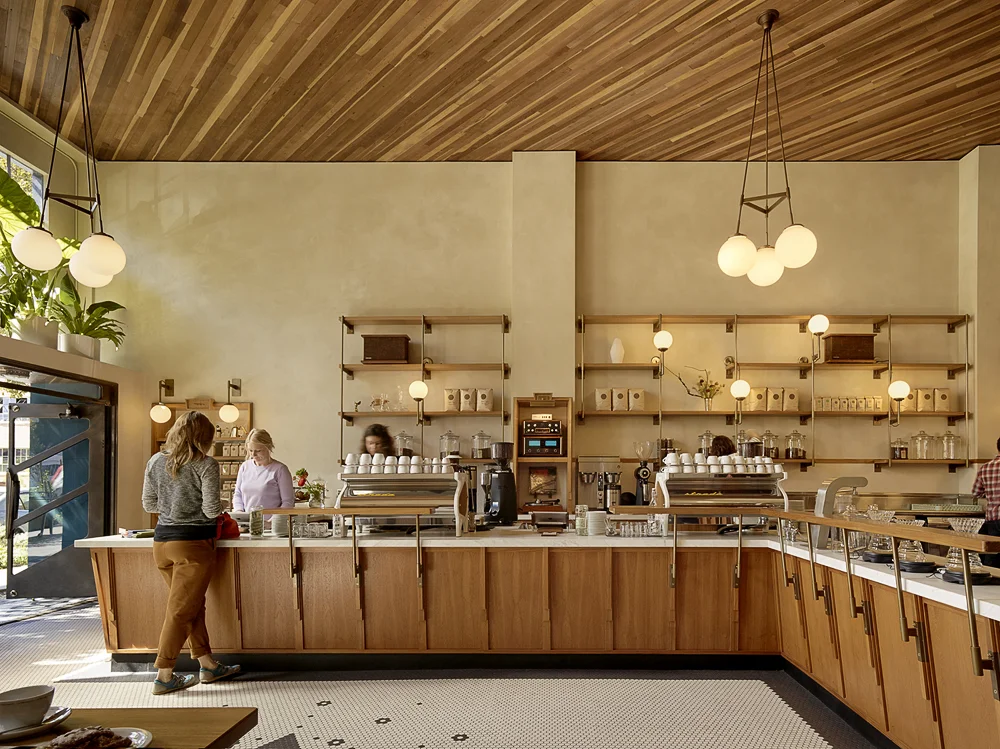


Sightglass on 20th has been open since 2014. What does it mean for a café interior to still feel right after more than ten years?
It’s genuinely rare. Hospitality interiors tend to follow the arc of whatever moment they were designed in — they peak early, then start to look like a relic of their era within a few years. The fact that Sightglass on 20th Street hasn’t followed that pattern says something important about the decisions Studio BBA made from the beginning. This wasn’t a space designed to look good in photographs at the moment of opening. It was designed to be lived in, worn in, and returned to — and that requires a fundamentally different set of priorities.
What were those priorities, and how do they show up in the space?
Materials and craft, above everything else. Studio BBA chose marble, plaster, teak, and dark brass — a palette that is refined without being precious, and that genuinely improves as it acquires patina. The building itself is a double-height industrial warehouse, and rather than fighting that or papering over it, the design works with the bones of the space. The description that comes to mind is an old-world café crossed with a sailboat cabin: light-filled and airy, but also distilled and purposeful. Nothing is there without a reason.


Studio BBA custom-designed almost everything in the space. What does that level of involvement actually look like in practice?
It means that fixtures, hardware, display cases, and finishes were all conceived as a family — related to each other, referencing each other, but each with its own iteration rather than being identical. Three custom chandeliers define distinct zones for customers and staff, and pull the eye upward toward the redwood sapwood ceiling, where a chevron pattern is laid out overhead. That same chevron motif was quietly introduced earlier in the steel entry door, so there’s a visual thread running from the moment you arrive to the moment you look up from your coffee.
The niches for merchandise and music equipment echo the detailing in the bar and seating areas. The brass pastry case is perhaps the most jewel-like object in the room — custom-crafted and positioned at standing height so that everything inside is immediately visible and accessible. These are the kinds of decisions that don’t announce themselves but add up to a space that feels considered at every scale.


The banquette is a particular feature. How was that designed?
With unusual care, actually. Studio BBA used a physical mock-up with sliding parts to work out the ideal dimensions for each type of seating before anything was built. The result is a sinuous cushioned banquette that wraps the perimeter and handles several different social situations within a single continuous form: solo outward-facing spots for people-watching, intimate two-person nooks, and a larger group area toward one end. Getting that right is harder than it sounds — seating that works for a person alone with a book needs to feel quite different from seating designed for a conversation, and the banquette manages to serve both without compromise.


There’s also a working roastery on site. How does that fit into the design?
Efficiently and inventively. A full-production roastery with a vintage Probat roaster is tucked into the layout alongside the espresso and pour-over bars, with customer circulation planned to keep everything flowing without congestion. The roastery isn’t hidden away — it’s part of the experience, a reminder that what’s in your cup was produced a few feet from where you’re sitting. That transparency between production and consumption is very much in the spirit of what Sightglass has always been about, and the design makes space for it without making a spectacle of it.


